

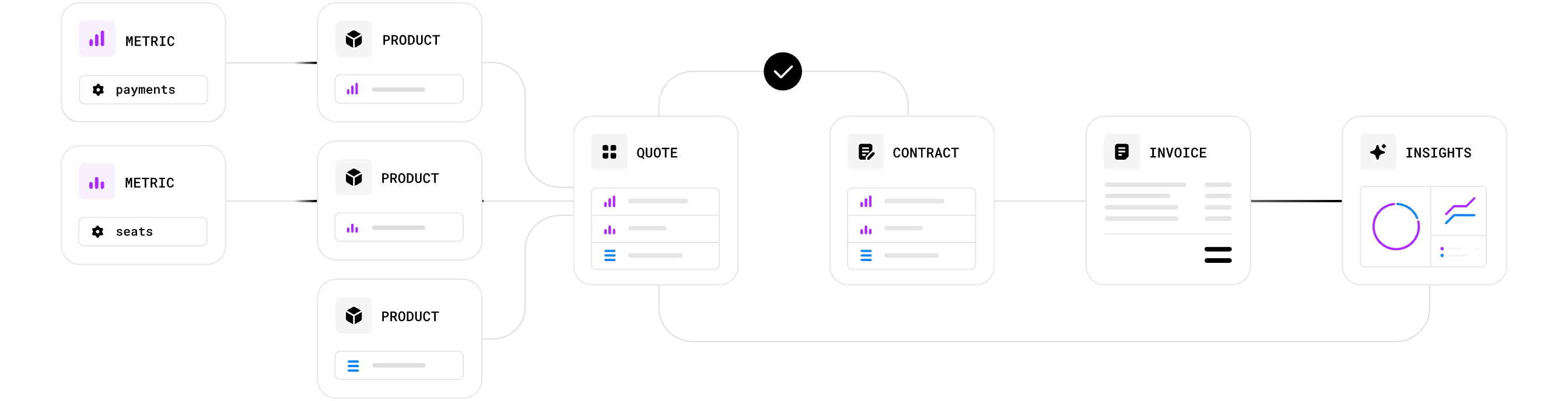
Billable Metrics
Units of measurement that determine how much a customer pays based on their actual usage. Real-world examples:- Twilio bills per SMS sent or API call made
- AWS S3 bills per gigabyte of storage used
- Snowflake bills per compute credit consumed
- Slack bills per active user in a workspace
CPQ / Quotes
Configure, Price, Quote — the process of creating customized pricing proposals for enterprise customers with complex needs. Real-world examples:- Salesforce enterprise deals with custom user counts, add-ons, and multi-year terms
- HubSpot packages combining Marketing Hub, Sales Hub, and Service Hub at negotiated rates
- Snowflake committed-use contracts with volume discounts based on projected consumption
Discounts
Price reductions applied to subscriptions or specific products. Real-world examples:- Spotify offers 50% off for students
- GitHub provides free or discounted plans for startups and nonprofits
- Annual billing discounts — most SaaS companies offer 15-20% off for paying yearly instead of monthly
- Volume discounts — Slack gives lower per-seat pricing as team size grows
Currencies
Support for billing customers in their local currency. Real-world examples:- Netflix charges €12.99 in Germany, ¥1,490 in Japan, $15.49 in the US
- Shopify displays pricing in local currencies while settling in USD
- Stripe handles currency conversion automatically for global sellers
Customers
Entities that subscribe to your product or service. A customer profile contains billing details, usage data, subscription status, and payment methods. Real-world examples:- In Slack, a customer is an organization with a workspace
- In Figma, a customer might be a design agency with multiple teams
- In AWS, a customer is an account that can have thousands of users underneath
Customer Portal
A self-service interface where customers manage their own billing without contacting support. Real-world examples:- Notion lets customers upgrade/downgrade, add seats, and update payment methods
- Zoom allows customers to view invoices, change plans, and manage add-ons
- Atlassian provides usage dashboards showing active users across products
Invoices
Detailed bills listing what the customer owes, including line items, taxes, and totals. Real-world examples:- Monthly Slack invoice: Base plan (437.50) + taxes
- AWS invoice: Hundreds of line items for EC2, S3, Lambda, RDS, etc.
- Stripe invoice: Platform fees, connect charges, and payouts itemized
Payment Transactions
The process of collecting money from customers — capturing funds, processing through payment gateways, and recording for accounting. Real-world examples:- Credit card charges processed through Stripe or Adyen
- ACH bank transfers for larger B2B transactions
- Wire transfers for enterprise contracts
- Auto-pay where saved cards are charged automatically, either when the invoice is issued or on its due date
Pricing Models
The structure that determines how products are billed.
See Pricing Models for detailed configuration options.
Products / Product Catalog
The specific offerings your company sells, organized in a catalog. Real-world examples:- Atlassian’s catalog: Jira, Confluence, Trello, Bitbucket (each sold separately or bundled)
- Microsoft 365: Word, Excel, PowerPoint, Teams, OneDrive (bundled into plans)
- Zoom: Meetings (core product) + Webinars, Rooms, Phone (add-ons)
- Fixed — same price regardless of usage (e.g., a software license)
- Metered — price varies based on consumption (e.g., API calls)
Usage Metering
Tracking customer consumption to calculate what they owe. Real-world examples:- OpenAI tracks tokens consumed per API call
- Datadog measures hosts monitored and logs ingested
- Vercel counts bandwidth used and serverless function invocations
- MongoDB Atlas monitors storage, operations, and data transfer
Plans
Predefined packages with specific features, limits, and prices. Real-world examples:
Plans simplify buying decisions by bundling features into clear options. Enterprise plans often serve as starting templates for custom negotiations.
Self-Serve Checkout
The process where customers sign up and pay without talking to sales. Real-world examples:- Canva — select plan, enter card, start designing in 30 seconds
- Notion — upgrade from free to team plan with a few clicks
- Vercel — connect GitHub, pick a plan, deploy immediately
Subscriptions
An ongoing agreement where customers pay recurring fees for access to products or services. Real-world examples:- Simple subscription: Spotify Premium at $10.99/month with monthly billing
- Annual contract: Salesforce at $1,500/user/year billed annually
- Complex subscription: Enterprise deal with base platform fee + per-seat charges + usage overages + multi-year commitment + annual price escalators
- Billing schedule — when invoices generate (monthly, quarterly, annually)
- Contract terms — commitment length and renewal rules
- Price changes — how upgrades, downgrades, and renewals are handled